Wake Forest, NC · Garage Door Service
Is Your Older Wake Forest Garage Door Worth Fixing
Wake Forest homes mostly date to the 1980s-90s boom, with stock running 1956-2013. Here's what that means for repairing versus replacing an aging garage door.
- Repairs & new doors
- Springs & openers
- Serving 4 nearby communities
What Local Conditions Do
Wake Forest sits in a cold-moderate climate band, which means the door on your garage goes through real freeze-thaw swings every winter and sticky, humid stretches every summer. That cycling is hard on a door that's been in place a while. Steel panels expand and contract, weatherstripping dries out and cracks, and any wood trim on an older door starts to cup or split at the seams.
Most of the housing stock here went up between 1956 and 2013, with the bulk of it landing in the 1980s and 90s across the twelve named pockets of the service area. That matters because a door installed during that build-out window is now thirty to forty years old. It was built to a lower standard than what ships today - lighter gauge steel, single-layer construction on a lot of the production-grade doors from that era, and hardware sized for a lighter door than current code assumes.
So when we look at an older Wake Forest door, we're not just checking if it still goes up and down. We're checking whether the materials and the climate have been fighting each other for three decades, and who's winning.
When It Stops Being a DIY Job
Tightening a loose hinge or lubricating a track is fine to do yourself. A torsion spring under tension is not. If your door is from that 1980s-90s wave of construction, the spring on it has likely cycled tens of thousands of times and the wire has fatigue you can't see from the ground.
It stops being a DIY job the moment you're dealing with anything under spring load, a bent track that's pulling away from the frame, or an opener that's cycling but not actually lifting the door square. On a door built during that era, the bottom bracket and the cable drum are also original hardware a lot of the time, and that's not something to loosen with the door sitting on a jack made of cinder blocks.
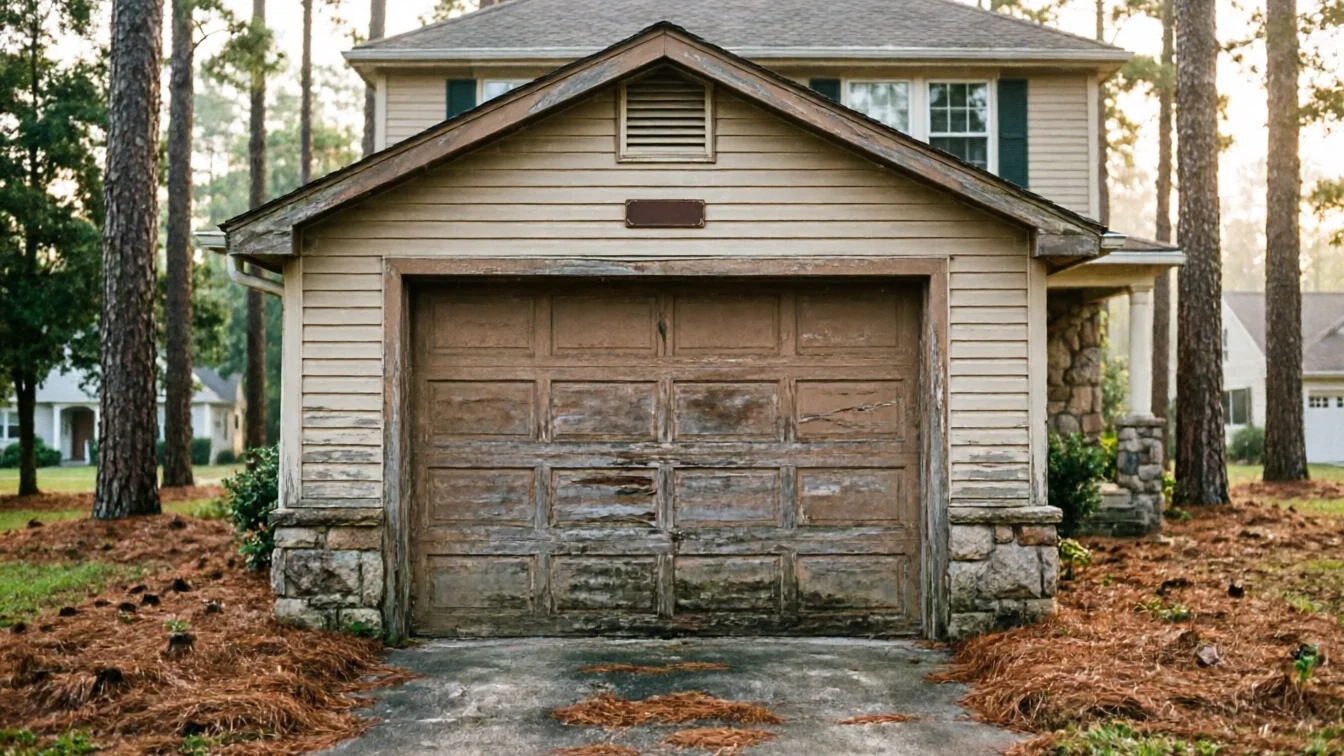
We'll also say plainly: if the door panels themselves are delaminating or the steel skin has rusted through at the bottom section - which we see on doors that have taken thirty winters of condensation in this climate - no amount of spring or track work fixes that. At that point you're not repairing a door, you're patching one, and it's worth saying so before you spend money on it.
What to Check
Before you decide anything, walk the door and look at these:
- Bottom panel condition. Rust-through or soft spots at the base section, common on doors that have sat through repeated cold-season condensation, usually mean the panel is done even if the rest of the door is sound.
- Spring wire. Visible gaps between coils, or a spring that looks stretched compared to its mate, is a sign of fatigue - not something to force closed by hand.
- Track alignment. On a thirty-plus-year-old door, check whether the track still runs parallel to the frame. A door from that 1980s-90s build period was hung to looser tolerances than current installs, and small shifts compound.
- Weatherstrip and bottom seal. If it's cracked, flattened, or missing chunks, it's cheap to replace and worth doing regardless of what else is going on.
- Opener age versus door age. If the opener has been swapped more recently than the door itself, don't assume the door's hardware matches modern lift specs.
If two or more of these come back bad at once, that's usually the point where a repair bill starts closing in on what a new door costs.
What Is Going On
Here's the honest math. Wake Forest's median household income runs around $68,485, and most owner-occupied houses in the service area - 14,339 of roughly 26,334 households - are the kind of mid-range single-family home that came with a builder-grade door back when it was put up. That door was never meant to be a forty-year part.
What's actually going on with most of the older doors we look at here isn't one dramatic failure. It's the slow accumulation of thirty years of cold-moderate seasonal cycling on steel and springs that were adequate for 1990 but are now past their design life. The track's a little bent, the spring's a little tired, the bottom seal's gone, and the panel's starting to show its age at the base. Any one of those is a repair. All of them together, on a door that's already thirty-plus years old, usually means the smarter money goes toward replacement rather than chasing the next failure six months from now.
We don't push replacement on a door that still has life in it - if the fix is a spring or a seal, we'll say so and do that instead.
Frequently asked questions
How old does a garage door have to be before repair stops making sense?
There's no fixed year, but once a door from the 1980s-90s building wave shows rust at the base panel and spring fatigue at the same time, you're usually looking at repair costs that creep close to a new door. We'd rather tell you that up front than fix one thing and have another fail in a few months.
Does Wake Forest's climate actually wear out garage doors faster?
The cold-moderate swings here mean steel panels and weatherstripping go through real expansion and contraction every year. Over thirty-plus years that adds up, especially on original builder-grade doors from the 1980s-90s construction period common across this area.
Is it safe to tighten a sagging spring myself?
No. A torsion spring under tension can cause serious injury if it lets go while you're working on it, and on an older door the wire may already be fatigued past what it looks like from the outside. That's one job we'd always rather you call for.
Related garage door services in Wake Forest
More garage door guides
Book garage door service in Wake Forest
Call now or request a quote - tell us what the door is doing and where you are.